
Scalable & Modular Automation
Buy the capacity you need today. Add the rest when the orders come.
Demand rarely grows in straight lines. A line sized for peak volume ties up capital for years.
A line sized for today hits its limit at the first large contract. We build automation on modular platforms: standardized base machines, stations that can be added, feeding and transfer systems that scale with the process. Capacity grows in steps, on a platform your team already knows.
From raw body to finished assembly.
One team answers for all of it.
Scalability
Start with the stations you need. The base machine is ready for the ones you will need.
Investment Protection
New stations and processes join the existing platform. The first investment keeps working.
Standardization
Operators and maintenance work on the same system at every size. Training doesn't start over.
Flexibility
Modular, transfer and feeding systems combine into production lines that scale with the required capacity and process.
We deliver the system.
You operate it.
High Speed Assembly & Inspection Cells
Okumat
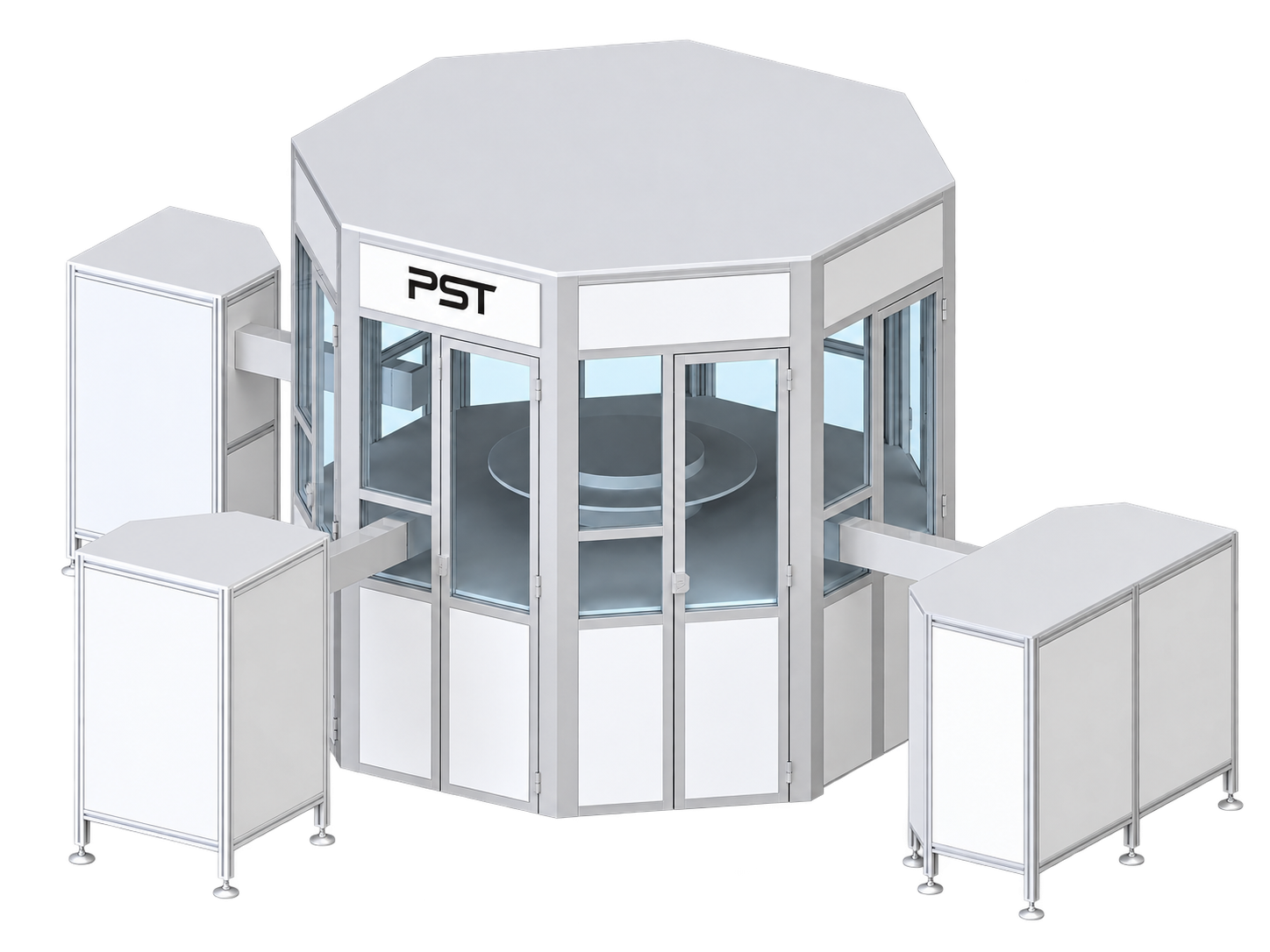
Capacity should grow in steps, not in rebuilds. OKUMAT arranges 8, 12, 16 or 24 stations around one central drive, so you start with the stations you need on a base unit that is ready for the ones that follow. Cams set the motion, which means the last station runs in exactly the same rhythm as the first. For assemblies with few individual parts there is the compact Modular Solution, for longer process chains the linear Transfer Solution.
Discover all High Speed Assembly Systems

Up to 300 parts a minute, and every one of them exactly where it belongs. Explore the high-speed assembly systems that turn many small components into finished products at a pace most lines never reach.

Downloads
We send datasheets and technical documentation on request.
Custom Solutions & Retrofit
System Upgrades
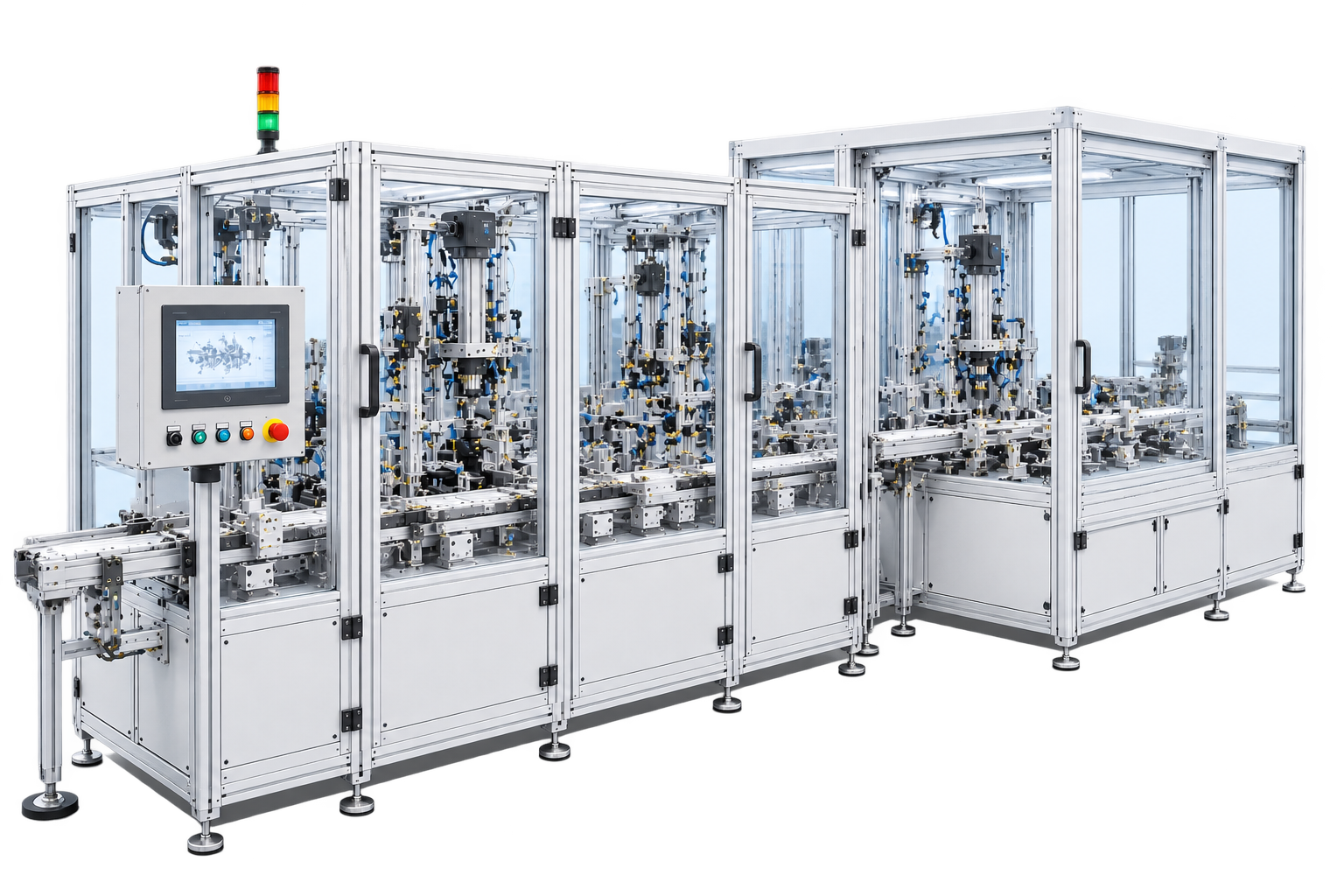
Orders rarely arrive in the size you planned for. System Upgrades extend an existing machine with additional stations, processes or capacity when you need it: new products, higher volumes, changed process steps. You stay flexible without investing in an entirely new system. If the limit is the control rather than the capacity, there are System Retrofits. If no existing machine fits the new process, there are Custom Machines.
Discover Custom Solutions & Retrofit
Your process is not in a catalog, and your machine should not be either. Explore how we build, extend and modernize production systems around what you make, from the first sketch to the last shift.
Downloads
We send datasheets and technical documentation on request.
One team from first sketch to a line that runs.
A process that has proven itself. One team plans, engineers and commissions your machine, and hands it over turnkey, ready to run, in the shortest possible time.

Planning
Concept, material flow and scope, defined with you before the first drawing is released.

Engineering
Mechanics, controls and process, designed as one system and simulated before the build.
Realization
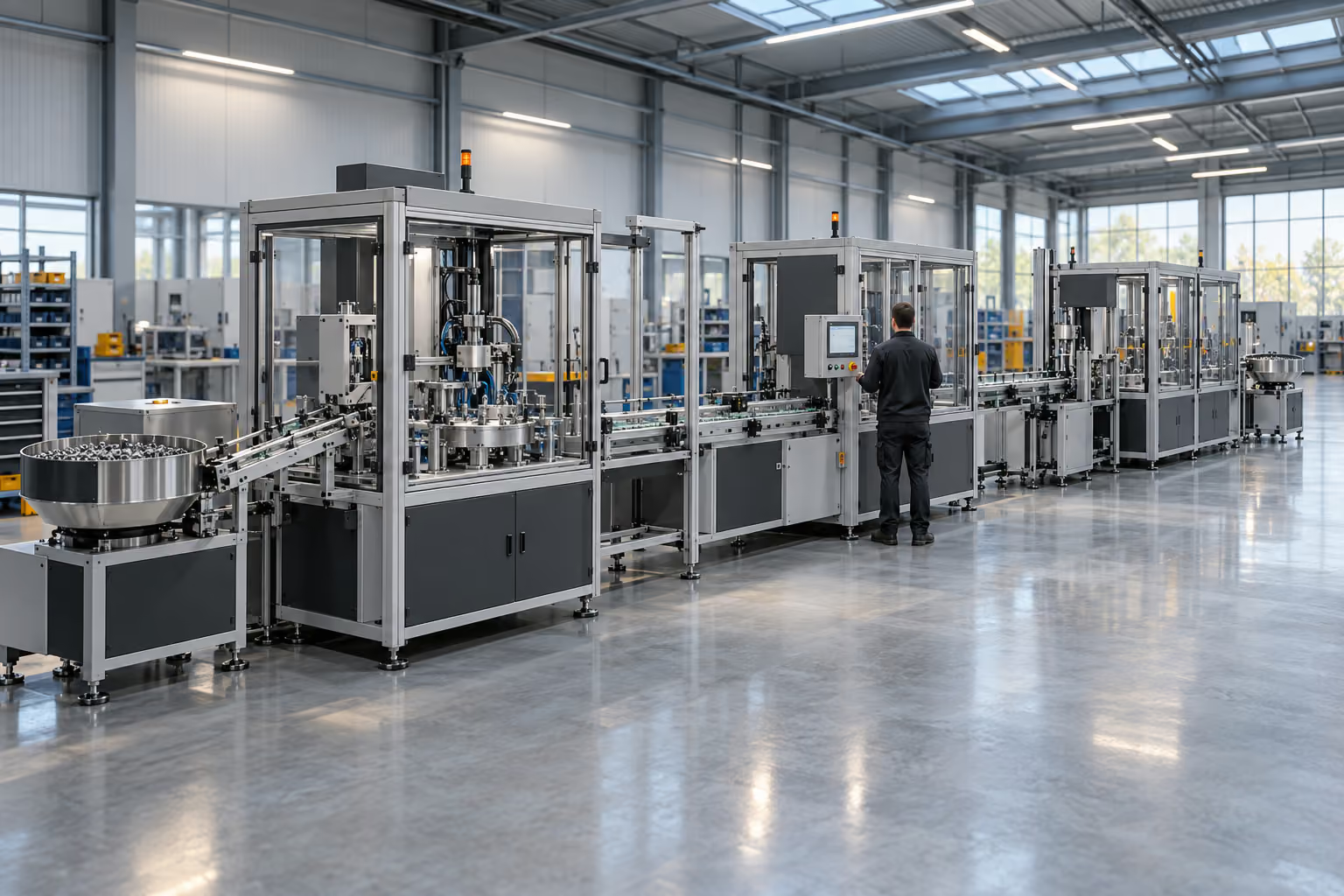
Build, installation and commissioning at your plant, then handed over ready to run.
Frequently Asked Questions
How many stations can an OKUMAT carry?
8, 12, 16 or 24 stations, arranged around one of three centrally driven base units. The base unit is chosen to fit the part and the process sequence.
What output can an OKUMAT system reach?
Between 10 and 300 parts per minute, depending on part size, number of components and process. The exact rate is set by the slowest process, so we design every station to match the target cycle.
Can stations be added to a Transfer Solution later?
Yes. The welded base frame can be planned with reserve positions, so new process steps are added without rebuilding the machine.
Can you add stations to a machine that is already running?
Yes. We extend existing machines with additional stations, processes or capacity. Preparation runs in parallel to production, and installation is scheduled into your planned shutdowns.
Can one system combine assembly, machining and robots?
Yes. Hybrid systems combine assembly modules, NC tables and robots. They process different workpieces on one line and can be expanded in stages.
Do you build complete lines or individual machines?
Both. We deliver single machines that drop into your existing line, and complete turnkey lines with feeding, assembly, machining and inspection. You choose the scope. We take responsibility for all of it.
Can the Modular Solution be added to an existing line?
Yes. Its compact frame is designed to fit into running production lines, upstream or downstream of existing machines.
Still have questions? Get in touch with our support team and we'll
discuss your unique requirements.
Why use cam-driven motion instead of servo axes?
Cams couple every station mechanically to one drive. Each cycle repeats exactly, even at high rates, with a repeatability below 50 µm. Where a process needs flexible motion, we add servo axes at that station.
Which process capability do you design for?
Critical features are designed for a machine capability index (Cmk) of 1.67 or higher. We prove it in a documented capability study with your parts before the machine ships. Process capability (Cpk of 1.33 or higher) is then confirmed in series production on your floor.
How do you prove a machine meets spec before it ships?
In a factory acceptance test (FAT) at our plant, with your parts, at full rate. We document output, capability and reject handling. After installation, a site acceptance test (SAT) confirms the same results on your floor.
Still have questions? Get in touch with our support team and we'll
discuss your unique requirements.
What does turnkey mean in practice?
One contract, one responsible partner. We deliver the complete system including feeding, safety technology and controls, commission it on your floor and hand it over after acceptance, ready to produce.
How does a project run from first request to acceptance?
Planning, engineering, realization, service. We define requirements and scope up front, build and test the system, and hand it over with acceptance testing. Timelines depend on the system and are agreed per project.
What happens after delivery?
Service continues after commissioning: support, spare parts, and upgrades to existing systems. Scope is agreed per system.
Still have questions? Get in touch with our support team and we'll
discuss your unique requirements.


Process System Technologies
Anton-Grimmer-Straße 4
73466 Lauchheim
Germany


