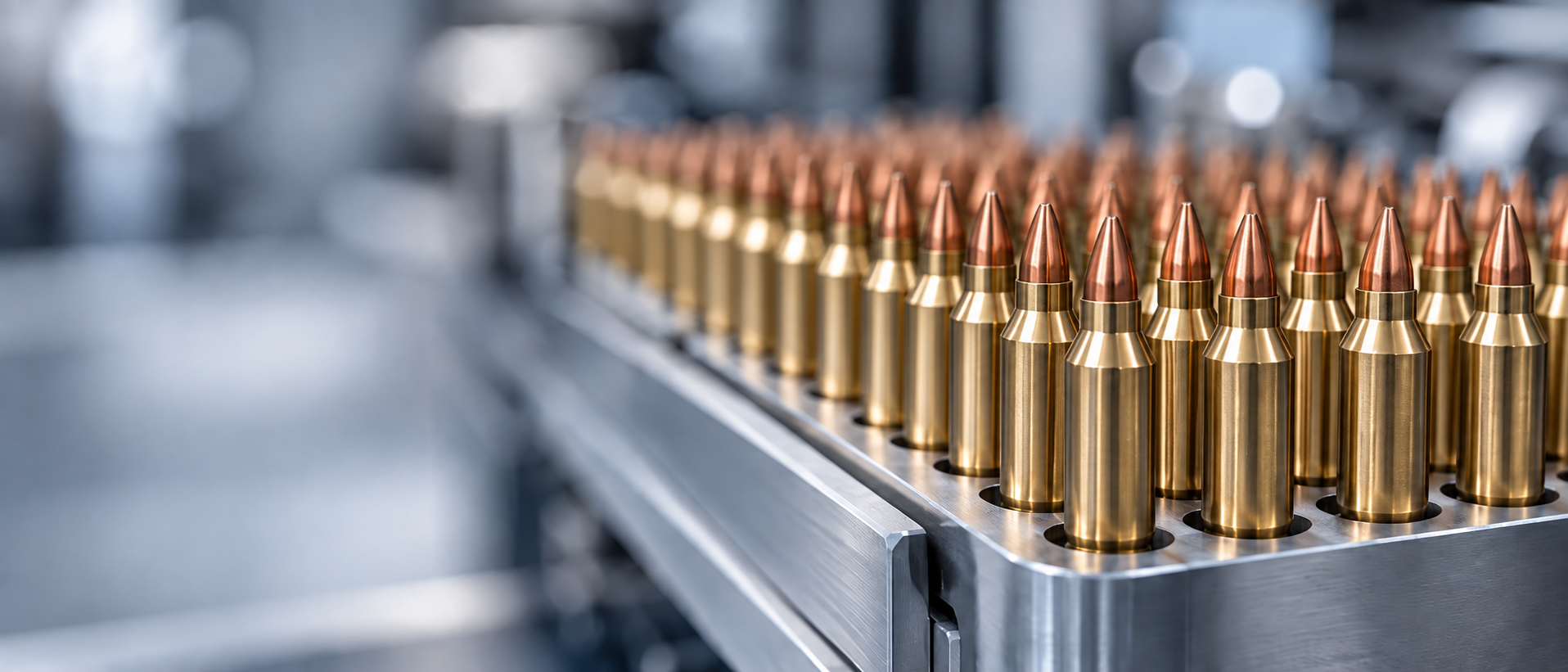

Small-Caliber Ammunition Assembly
A misseated primer doesn't announce itself. It fails in the chamber.
Small-caliber output is counted in millions of rounds, and demand has outgrown the lines built to supply it. Speed alone solves nothing if one weak crimp or one wrong charge weight slips through. We build assembly and inspection systems that load, seat, crimp and verify every round at full line rate. Each critical dimension is measured, each charge checked, each result logged to its lot. The line runs faster. Inspection keeps pace with production.
From raw body to finished assembly.
One team answers for all of it.
Throughput
Rotary indexing keeps every station working on every cycle. Output climbs without stretching any single process.
Verification
Primer seat depth, crimp force and charge weight are measured on every round. Not on a sample.
Traceability
Every result is tied to its lot. One query shows what was built, when, and against which limits.
Changeover
Caliber tooling swaps as a set. The line is designed to return to rate in under ten minutes.
We deliver the system.
You operate it.
High Speed Assembly & Inspection Cells
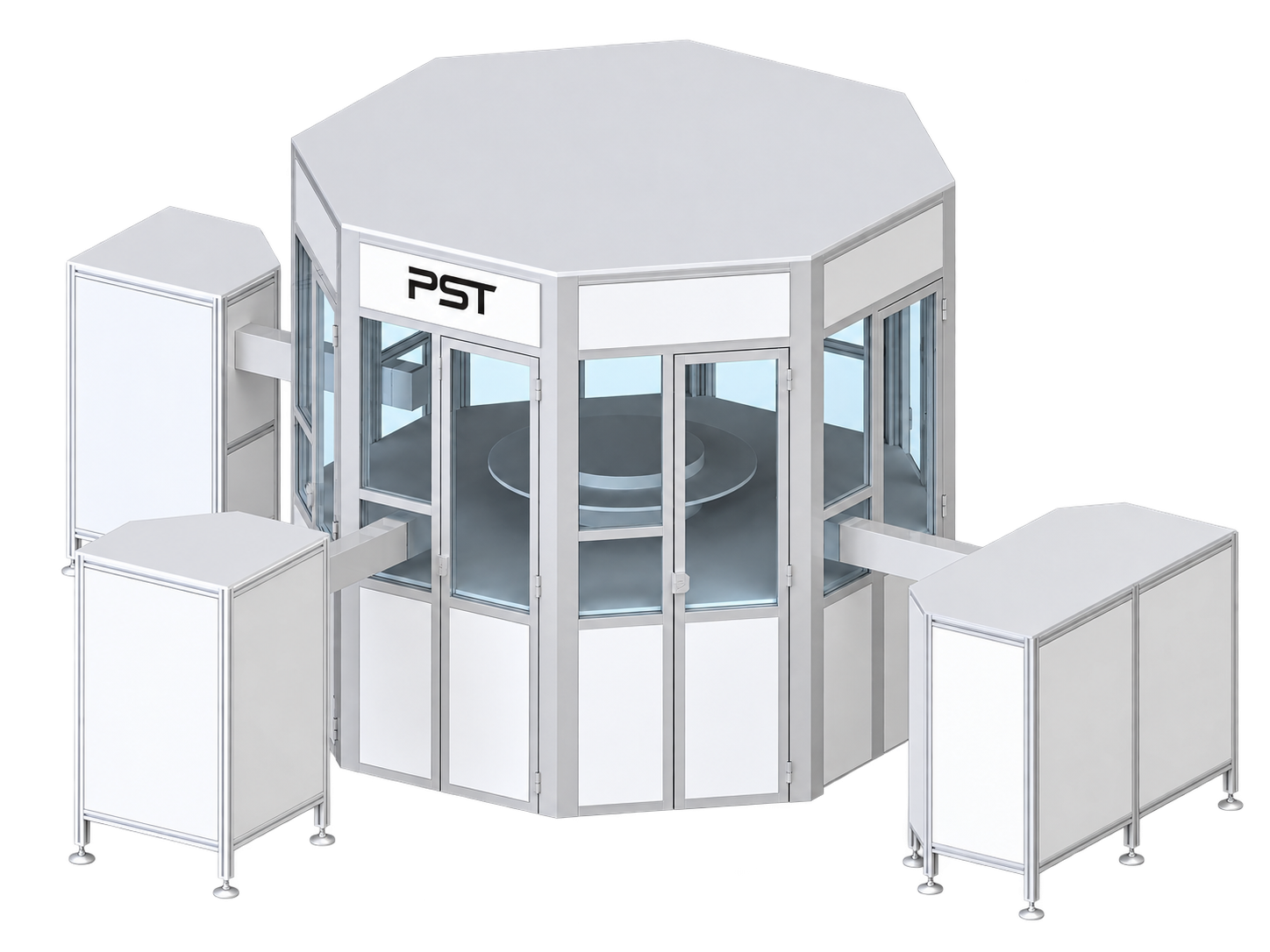
OKUMAT
A line that fills millions of rounds has to run fast without letting any single step slip. OKUMAT keeps every station working in every cycle: up to 24 stations around one central drive, cams setting each motion, and output from 10 to 300 parts per minute depending on the system. Because the movement repeats exactly, inspection can keep pace with production. For assemblies with few individual parts there is the compact Modular Solution, for longer process chains the linear Transfer Solution.
Discover all High Speed Assembly Systems

Up to 300 parts a minute, and every one of them exactly where it belongs. Explore the high-speed assembly systems that turn many small components into finished products at a pace most lines never reach.

Downloads
We send datasheets and technical documentation on request.
Custom Solutions & Retrofit
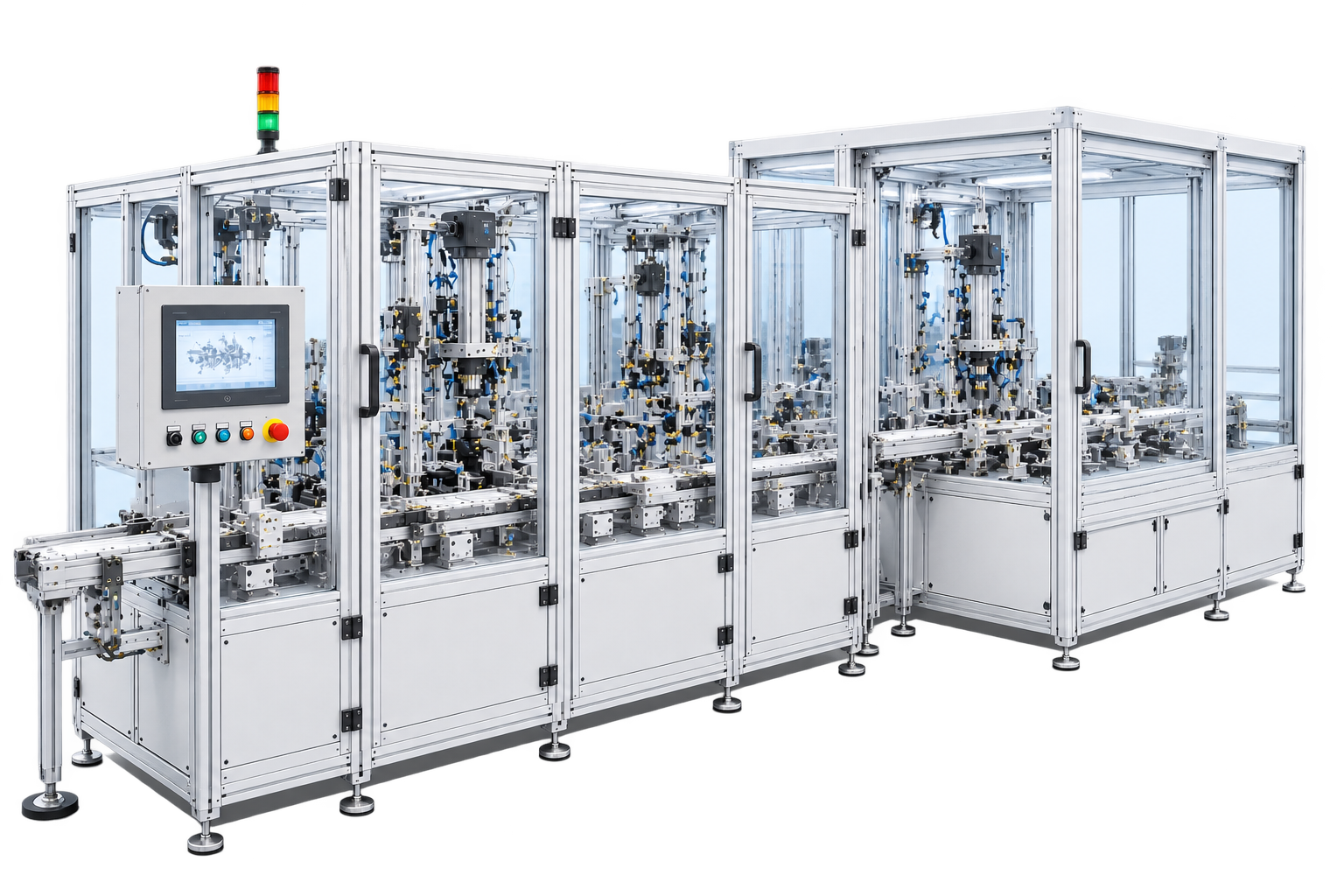
System Upgrades
When demand outgrows a running line, the first answer should not be a new line. System Upgrades extend an existing machine with additional stations, processes or capacity when you need it: higher volumes, changed process steps. You stay flexible without investing in an entirely new system. If the control is what holds the line back, there are System Retrofits.
Discover Custom Solutions & Retrofit
Your process is not in a catalog, and your machine should not be either. Explore how we build, extend and modernize production systems around what you make, from the first sketch to the last shift.
Downloads
We send datasheets and technical documentation on request.
One team from first sketch to a line that runs.
A process that has proven itself. One team plans, engineers and commissions your machine, and hands it over turnkey, ready to run, in the shortest possible time.

Planning
Concept, material flow and scope, defined with you before the first drawing is released.

Engineering
Mechanics, controls and process, designed as one system and simulated before the build.
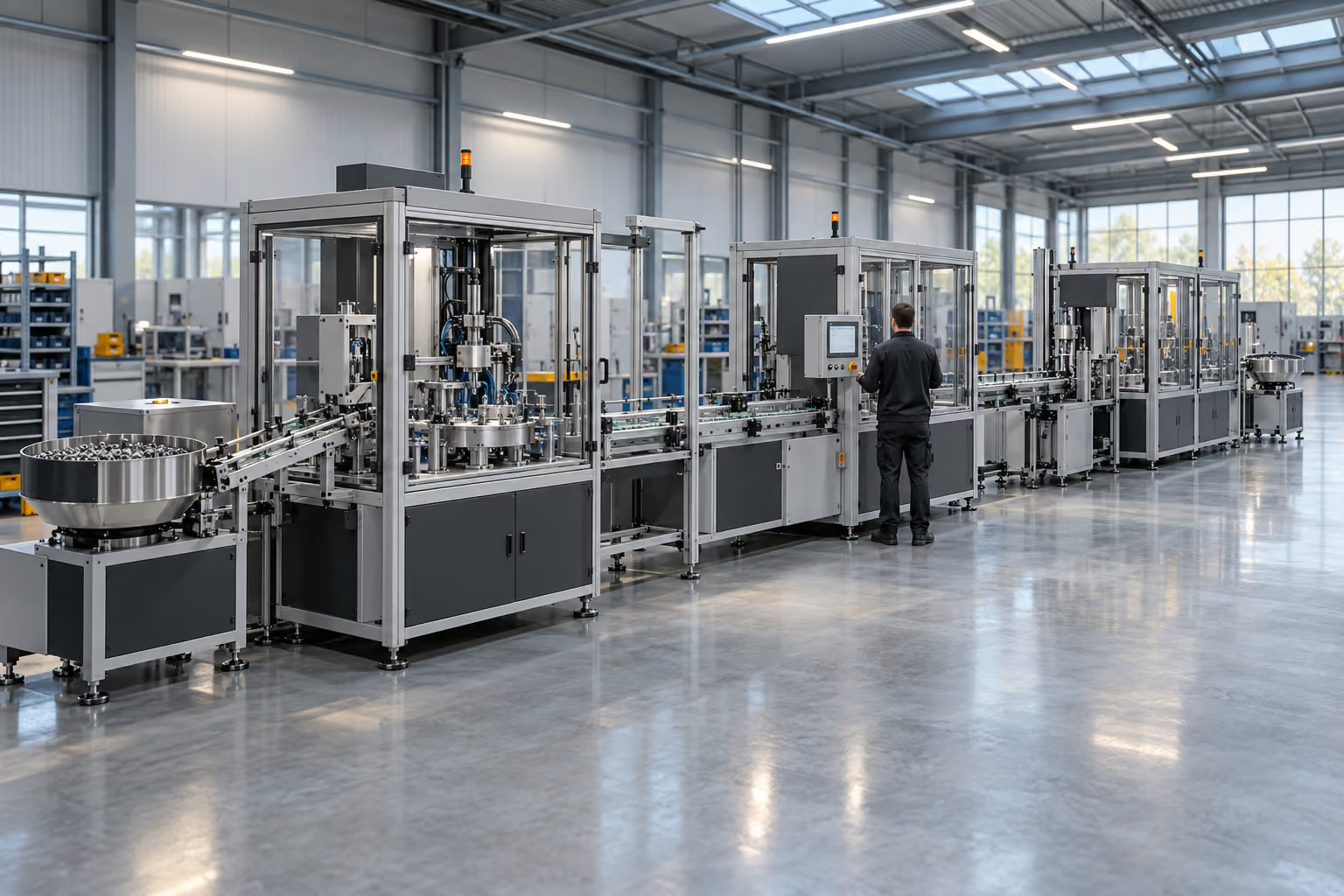
Realization
Build, installation and commissioning at your plant, then handed over ready to run.
Frequently Asked Questions
What output can an OKUMAT system reach?
Between 10 and 300 parts per minute, depending on part size, number of components and process. The exact rate is set by the slowest process, so we design every station to match the target cycle.
Which processes can run on an OKUMAT?
Press-fitting, screwing, crimping, riveting, welding, dispensing, marking, camera inspection and leak or function testing. Assembly and verification run on the same machine, in the same cycle.
Which feeding technologies do you use?
Vibratory bowl feeders, linear and step feeders, and flexible feeders with vision for complex parts. The technology is chosen by part geometry, surface and rate.
Still have questions? Get in touch with our support team and we'll
discuss your unique requirements.
How is every unit verified?
Inspection is part of the process, not a step after it. Each unit is checked in the line, and the result is stored against the part. Nothing moves to the next station without a pass.
What traceability do you provide?
Every part and batch is documented through the process: which station, which parameters, which result. Traceability is configured to your requirements, down to part and batch level.
Which process capability do you design for?
Critical features are designed for a machine capability index (Cmk) of 1.67 or higher. We prove it in a documented capability study with your parts before the machine ships. Process capability (Cpk of 1.33 or higher) is then confirmed in series production on your floor.
How do you protect confidential projects?
Confidentiality starts before the first drawing: a non-disclosure agreement, access on a need-to-know basis and separated project areas in our facility. Your parts, data and drawings stay inside the project team.
How do you prove a machine meets spec before it ships?
In a factory acceptance test (FAT) at our plant, with your parts, at full rate. We document output, capability and reject handling. After installation, a site acceptance test (SAT) confirms the same results on your floor.
Still have questions? Get in touch with our support team and we'll
discuss your unique requirements.
Can you test our parts before we place an order?
Yes. For critical joining, machining or inspection steps, we run feasibility trials with your sample parts. You see the result before you commit to the machine.
How long does a project take from order to acceptance?
Systems based on our standard platforms typically take six to nine months. Complex lines with machining, assembly and inspection take nine to fourteen months. The binding schedule is part of every offer.
How does a project run from first request to acceptance?
Planning, engineering, realization, service. We define requirements and scope up front, build and test the system, and hand it over with acceptance testing. Timelines depend on the system and are agreed per project.
Still have questions? Get in touch with our support team and we'll
discuss your unique requirements.


Process System Technologies
Anton-Grimmer-Straße 4
73466 Lauchheim
Germany


